Navigation and radar · 12 min read · Updated 2026-08-21
Marine radar buying guide — dome vs open array
Dome radars win on sailing masts and trailer-boat arches. Open arrays win on range and target separation. Australian water decides the rest.
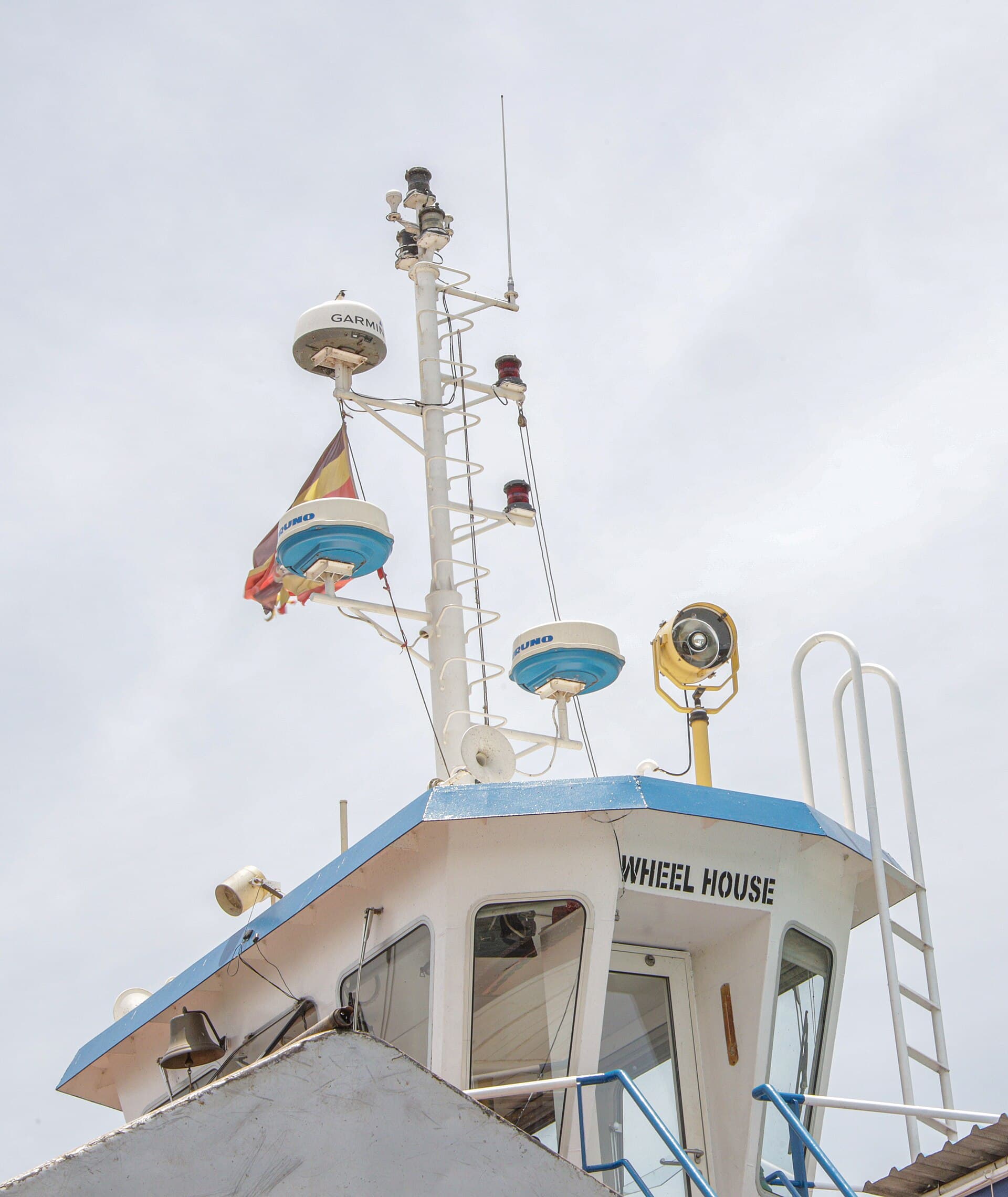
Photo: Wheelhouse roof with Garmin radar and communication gear by Ssemmanda will. Licensed under CC BY-SA 4.0. Source on Wikimedia Commons. Also listed on the AM Wholesale image credits page.
Radar is a radio that measures echoes. Everything else — bird mode, Doppler paint, overlay on a pretty chart — is software. The mechanical choice that still matters on Australian boats is dome versus open array, because that choice is about weight, windage, beamwidth and whether the scanner can live where you want to put it.
The archived AM Wholesale catalogue listed dome scanners, open arrays, and power from small 2 kW units through to long-range sets. Those numbers have shifted with solid-state and Doppler, but the geometry has not.
Why beamwidth is the real spec
A wider antenna (usually an open array) throws a narrower horizontal beam. Narrower beams separate two targets that a small dome will smear into one blob. That is why a 4-foot array still earns its place on a flybridge that runs shipping or watches a storm cell 20 miles out.
A 18- or 24-inch dome has a wider beam. It is lighter, safer on a sailing mast, happier on a trailer-boat arch, and entirely useful for “what is in the rain at two miles” on Moreton Bay.
Dome radars
Choose a dome when:
- the boat is a sailing cruiser and the mast already carries enough windage
- the boat is a trailer boat or a 30-foot sports cruiser with an arch, not a sky-high radar pedestal
- your night work is coastal, not a watch-keeping job
Mounting height helps range, but a high dome next to a satdome or a wind instrument will paint your own boat. Give it sky.
Open arrays
Choose an open array when:
- you have the roof or mast structure to carry it without a new engineering argument
- you want target separation in traffic or around storm cells
- the boat already thinks of itself as a small ship
Open arrays need guarding, a respectful crew, and a power story. They also need the same heading sensor the MFD needs, or the overlay will lie. That is a NMEA 2000 job.
Power, Ethernet and the rest of the helm
Modern solid-state scanners sip compared with the old magnetron sets, but they still want a clean Ethernet or manufacturer backbone back to the MFD. A radar that only talks to one brand of glass is a brand-family decision.
Radar does not replace AIS. Ships can sit in clutter; AIS can sit in a GPS lie. Together they are a lookout. Alone, each has a favourite way to fail.
If you are scoping the whole 40-footer, return to the electronics package planner. If you only run in daylight, spend the money on a better heading sensor and a current chart card first — then come back to radar when you start night hops.
Frequently asked questions
- Is a 24-inch dome enough for Moreton Bay?
- Yes for weather cells, barges and night entries if it is mounted in the clear and networked to a heading sensor. It will not give you the long-range discrimination of a 4-foot open array. Buy the dome if the mast or arch cannot carry the array.
- Do I need Doppler radar?
- Colour-coded closing targets are a genuine help in traffic. They are not a substitute for a heading sensor, a truthful overlay or a skipper who still looks out the window.
- Can radar see the Gold Coast Seaway leads in rain?
- Rain clutter settings and a decent scanner help. Radar will not turn a bad bar forecast into a good one. If the Seaway is closed, stay in the Broadwater.