Marine electronics · 13 min read · Updated 2026-08-19
NMEA 2000 refit guide for Australian boats
A backbone is cheaper than a second failed plotter. This is how Australian yards actually lay NMEA 2000 — and where 0183 still earns a seat.
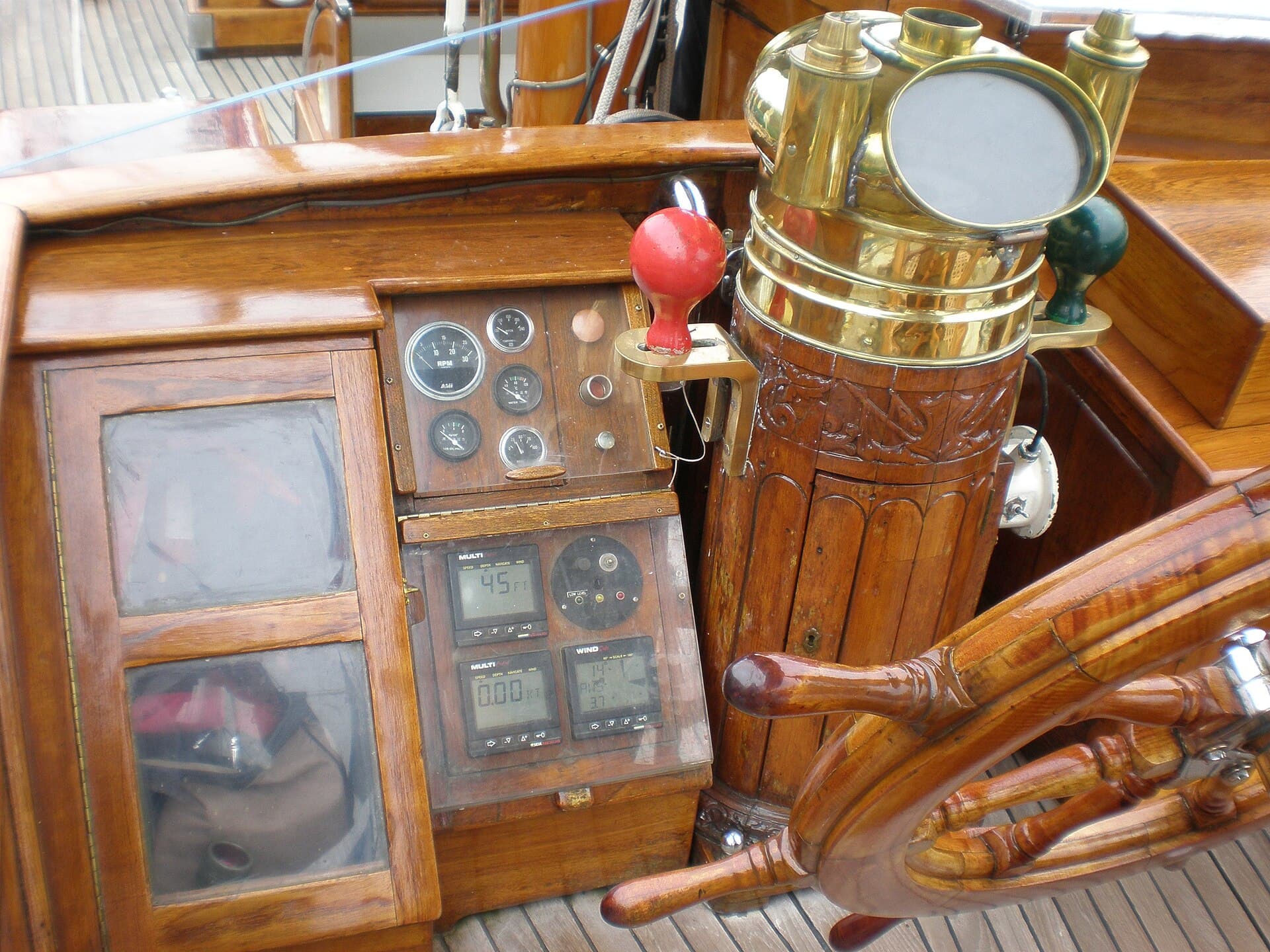
Photo: HMCS Oriole steering wheel, readouts and compass by BrokenSphere. Licensed under CC BY-SA 3.0. Source on Wikimedia Commons. Also listed on the AM Wholesale image credits page.
NMEA 2000 is a 12-volt, two-terminator, one-power-insert network. It is not “plug and play” in the smartphone sense. It is plug-and-play in the marine sense: if the backbone is laid like a backbone, most certified devices will share position, depth, wind, heading and battery data without a technician writing a driver.
Australian refits go wrong when a new MFD is dropped onto a nest of leftover SeaTalk, 0183 talkers and unpowered tees. This guide is the order of work the old Coomera desks used to talk through before anyone ordered glass.
Draw the network before you buy the screen
List every talker and listener: GNSS, heading, depth, wind, AIS, radio, autopilot, battery monitor, stereo. Mark which of those already speak NMEA 2000, which speak 0183, and which are proprietary Ethernet (Raynet, Garmin Marine Network, Simrad Ethernet).
An MFD without a heading sensor will overlay radar and AIS badly. An autopilot without a reliable heading and speed sentence will wander on a Broadwater run-in. That is a network problem, not a “the plotter is junk” problem. See the chartplotter versus MFD explainer if you are still naming the glass.
The physical rules that actually matter
- One linear backbone, not a star of random tees behind the helm.
- A 120-ohm terminator at each end. Two, not one, not three.
- Power inserted near the middle of the load, through a fused tap, not through an instrument.
- Drop cables short enough that the spec is not a suggestion. Long drops are how you get ghost devices and flickering wind.
- Cable that is actually NMEA 2000 / DeviceNet rated. Figure-eight speaker wire is how you spend a Saturday.
Queensland engine rooms are hot. Do not hide the power insert against an unventilated locker and then blame the display when voltage sags.
0183 still has a job
Plenty of Australian boats still have a working 0183 autopilot, a DSC radio that wants a GLL sentence, or an AIS that only talks 38400 baud. A small gateway keeps those devices. Replacing a healthy course computer because the new MFD is 2000-only is how refits blow their budget.
What you should not do is build a new network on 0183. One talker, one listener, and a rats-nest of multiplexers is the 1998 solution.
Power is part of the network
NMEA 2000 is a 12-volt network. On a 24-volt house bank you still need a regulated 12-volt feed to the insert, or certified 24-volt devices and a plan. A tired cranking battery that also feeds the backbone will reboot the plotter when you start the motors. That is why this piece sits next to onboard power and dual-battery systems.
Commissioning, not just connecting
After the last tee goes on, walk the device list on the MFD. Confirm unique instance numbers. Confirm the GNSS is the one on the cabin top, not the one inside a phone. Confirm the heading sensor is calibrated away from speakers and winch motors. Then sea-trial: a five-minute pontoon test does not show a heading that lags on a turn out of the Coomera River.
If radar or AIS is in the job, continue to GPS plotter installation mistakes and AIS Class A versus Class B. If the display family is still open, use the Raymarine, Garmin, Simrad and Furuno comparison.
Frequently asked questions
- Can I mix Raymarine, Garmin and Victron on one NMEA 2000 backbone?
- Usually yes for the common PGNs — GPS, depth, wind, battery and AIS. Manufacturer-specific pages (some sonar, some autopilot controls, some stereo) still want that brand’s Ethernet or SeaTalk backbone. Test the sentence you care about, not the marketing sticker.
- Do I need a drop cable for every instrument?
- Yes. NMEA 2000 is a backbone with tees and drops, not a daisy-chain of random leads. Drops should stay short. The backbone gets the two 120-ohm terminators, one at each end, and a single power insertion point.
- Is NMEA 0183 dead on Australian refits?
- No. Plenty of Autopilots, older AIS units and some radios still speak 0183. A gateway is cheaper than throwing away a working course computer. Just do not build a new boat on 0183 alone.