Onboard power · 12 min read · Updated 2026-09-08
Victron marine power systems for Australian boats
Victron became the Australian default because the pieces talk to each other. The useful job is architecture — alternator, charger, inverter, monitor — not collecting blue boxes.
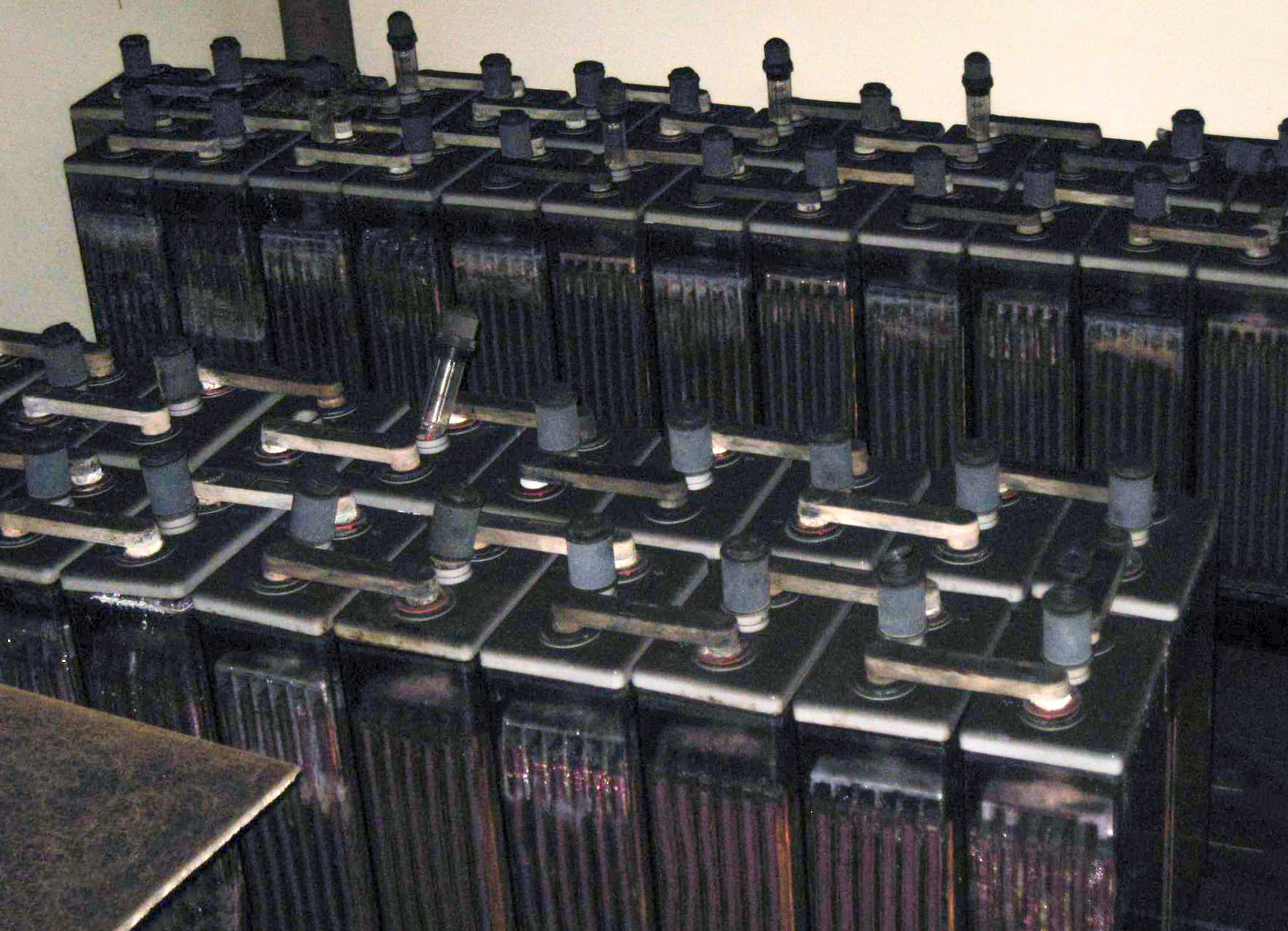
Photo: Lead-acid accumulators by Pseudoznanstvenik. Licensed under CC BY-SA 3.0. Source on Wikimedia Commons. Also listed on the AM Wholesale image credits page.
The archived AM Wholesale power shelf put Victron next to Mastervolt, Intervolt and Federal batteries because electronics sales die on a tired bank. Victron won the Australian leisure-marine argument by making the boxes a system: chargers, inverter/chargers, DC-DC, MPPT, shunts and a GX brain that can sit on NMEA 2000.
This is not a catalogue. It is the order of a power job.
Draw the loads first
List the things that run at anchor and the things that run underway: MFD, radar, autopilot, fridge, watermaker, inverter kettle, lighting. Give each a current and a duty cycle. A 2,000-watt inverter that might see a kettle is a different house bank to a 300-watt inverter that charges a laptop. See inverter sizing.
Then the chemistry
AGM is still a sane, heat-tolerant Australian house battery if you will not cycle it hard. Lithium (LiFePO4) is the liveaboard and serious-cruiser answer if the charger, the alternator and the BMS are a designed set. Read lithium versus AGM before you buy a drop-in miracle.
Then the charge sources
- Shore: a charger or inverter/charger that matches the bank and the marina’s 240-volt manners.
- Alternator: a DC-DC charger on most trailer boats and many cruisers, or an external regulator on a high-output alternator. Do not let a lithium bank ask an unregulated alternator to die.
- Solar: MPPT sized to the panel, with shade on an Australian bimini treated as a fact.
- Generator: if you have one, it is a charge source, not a personality.
Trailer boats can stop at DC-DC plus isolation. See dual-battery systems.
Then the monitor
A shunt-based monitor (Victron BMV or SmartShunt class) tells you amp-hours, not a cartoon battery icon. A GX device is how solar, inverter and lithium stop being three rumours. Put the display where you sit at 21:00, not in the engine room.
Heat, salt and Queensland
Mount inverters where they can breathe. Keep shunts on the negative where the manual says. Fuse at the source. Queensland engine rooms will cook a charger that was specified for a Dutch garage. Give the metal air.
Victron is a language, not a religion. Mastervolt and other inverter/charger houses still appear on Australian motor yachts. What you must not do is mix charge algorithms on one lithium bank and hope. If the job also includes a desalinator, read choosing a watermaker so the high-pressure pump is in the load list, not a surprise.
Frequently asked questions
- Do I have to use Victron for a lithium house bank?
- No, but you do have to use a charger, alternator regulator and monitor that understand the chemistry. Victron is common in Australian yards because the Cerbo/GX story and the dealer network are already here. A mixed-brand lithium job needs a grown-up diagram, not a hopeful Facebook thread.
- Can a trailer boat use Victron?
- Yes. A DC-DC charger, an isolation switch and a house battery is a Victron-shaped job even on a 6-metre hull. You do not need an inverter/charger to earn the architecture.
- Is a GX display mandatory?
- No. It is how you stop guessing. If the boat has solar, lithium and an inverter, a monitor you can read at the nav station will save a Saturday.