Marine lighting · 10 min read · Updated 2026-08-15
Spreader and flood lights for Australian night fishing
Work lighting is a beam, a switch and a courtesy toward the next skipper. This is how to light a deck at 2am without building a lighthouse.
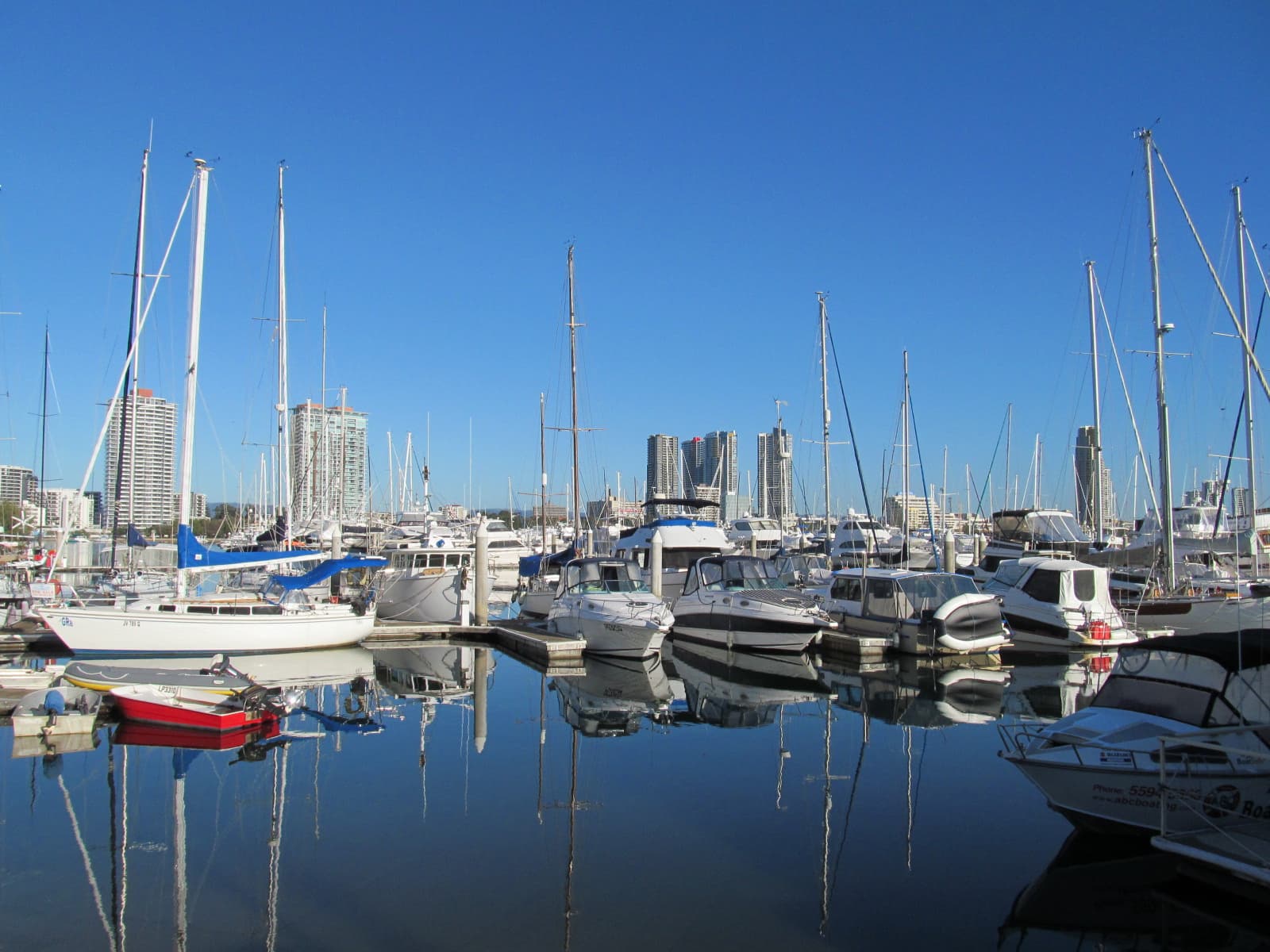
Photo: Southport Yacht Club boats at Main Beach by orderinchaos. Licensed under CC BY-SA 3.0. Source on Wikimedia Commons. Also listed on the AM Wholesale image credits page.
Night fishing on the Australian east coast is a lighting job before it is a sonar job. You need to see the deck, the transom, the rocket launcher and the person on the gunwale. You do not need to illuminate the next postcode. The archived Lumitec and Hella ranges at AM Wholesale existed for that distinction: spreader, flood, courtesy — not a single light bar doing every job badly.
Aim down
A spreader or a flood that points at the water ahead of the bow is a courtesy failure and, in a channel, a safety failure. Aim at the deck and the working cockpit. Use a visor or a housing that stops upward spill. If you must light a bait trail, do it with a dedicated, dimmable fitting, not by tipping the arch light at the horizon.
Separate the circuits
- Nav lights: always on when underway at night. See COLREGs navigation lights.
- Work floods / spreaders: switched, fused, off when you are underway in traffic.
- Courtesy: dim, warm, enough to walk forward without a broken toe.
- Underwater: decorative or fishing theory, never a substitute for the above. See underwater boat lights.
Size for the hull and the battery
Trailer boats: one or two compact marine floods and a pair of courtesy LEDs. Read LED lighting for trailer boats and dual-battery systems.
Cruisers and workboats: spreaders on the arch or mast, a cockpit flood, an engine-room lamp you can actually replace, and a house bank that knows about them. Extreme-duty floods in the 10,000-lumen class exist for commercial decks. They are not a personality upgrade for a 6-metre yellowfin.
Colour temperature and night vision
Cool white is crisp and ugly on a helm full of glass. Warm white keeps night vision closer to usable. Red courtesy is a gift at 02:00 if you still have to read a plotter. Do not mix a 6500 K flood with a red courtesy and then wonder why the cockpit looks sick.
The test
Rig the lights on the hardstand, at night, with a friend 50 metres away. If they cannot tell your port from your starboard, you have buried the nav lights. If they need sunglasses, you have built a lighthouse. Fix the aim before you drill a second hole.
For the rest of the night-running kit — radar, AIS, thermal — use the navigation hub and night vision cameras.
Frequently asked questions
- How many lumens is too many on a 7-metre boat?
- If you cannot look at the deck without squinting, or the skipper in the next anchorage can read by your spreader, it is too many. A sealed marine flood in the 1,000 to 3,000 lumen class, aimed down, is the usual trailer-boat and small-cruiser answer.
- Should work lights be on the nav-light switch?
- Never. Navigation lights stay up all night. Work lights go off when you do not need them, and always when another vessel is trying to read your arcs.
- Are RGB “party” modes useful for fishing?
- They are useful for a pontoon photo. For working a fish, white or a warm white that does not wreck night vision is the grown-up setting.